Search This Blog

Wednesday, 7 September 2011

THE WHOLE DAME THING

In the ‘Production Notes’ I include with my pantomime scripts, I offer a brief description of the characters. For every Dame, this is exactly the same… ‘The traditional Dame, best played by a man, who should not attempt to play the part of a real woman. Dames are not 'drag' parts. She carries the large part of the comedy. A sprightly, forceful character, who drives the whole show. Physicality is all-important. Body language and facial expressions should be big and bold. Requires the ability to put over a song.’

That’s it in a nutshell, whether it be Widow Twankee, Sarah The Cook, or Mother Goose. The rest is in the script for the actor to discover for himself… providing he is prepared to do that.

Here’s a quote from ‘Plays And Players’ December 1977, about the approach to playing Dame adopted by Stanley Baxter, who was a great favourite on the Scottish pantomime circuit, until his retirement in 1991. In the evolution of a performance… (he) doesn’t think about where he’ll get laughs until a very late stage. The early work is concentrated on those dramatic high points that he regards as keys to his character’s development.”  The man is obviously a professional.

I don’t like Dames who are trying to be a solo act. They must be a character in the show, and not a show-off. The actor should never forget that he is playing a role, and as such is only one piece in the jigsaw.

Chris Harris, quoted on the BBC website, "When I come to do the panto dame I think what I try to do is try and bring an actor to work rather than a drag act."

There appears to be a trend these days towards Dames being far removed from reality. Costumes are of a kind that only a pantomime Dame would wear, and make up is becoming bizarre. There is a ‘tutorial’ on YouTube where the end product looks just like someone with their face painted.

Arthur Askey, who played Dame at the London Palladium in the 1960s made up with “ordinary pancake slap”, as he would have done for any appearance on stage. He wore a basic wig, and a basic costume, but the guy was funny, despite, or maybe because of, the lack of artificial aids.

Les Dawson, who was inspired by another Palladium Dame, the great Norman Evans, simply painted his nose red and wore a pair of wire-rimmed spectacles. Chris Harris also uses a fairly basic make up.

For me, the greatest ‘Dame’ of them all was Arthur Lucan, alias Old Mother Riley, who played the Palladium and the Royal Command Performance, as the Irish washerwoman character, without exotic make up, crazy costumes, or false boobs. I did say I liked physical comedians and comediennes, didn’t I?

Chris Harris again… "Arthur Lucan played this woman called Old Mother Riley who had a daughter Kitty, he's the nearest to what I always thought panto dames should be, a totally believable character, always wringing his arms, she was always busy and ran a laundry like Widow Twankey does.”

A guy I knew played Dame in local pantomimes, and for him, the costumes were the most important part of his performance. He would write in his script, ‘Costume Number 1’, up to ‘Costume Number 8’, or even higher, at the points where he made an entrance in a different ‘dress’.

Anyone can wear outrageous costumes, but not everyone can be funny on stage, regardless of what they are wearing. Funny is more important than frippery. All right, let’s say you make an entrance in an outrageous costume, that has taken someone quite a long time to make, and has cost a pretty penny. When the audience first clocks it, they laugh… once! Is all that effort really worth one whoop?

A bit of comedy business or a comedy prop on the entrance might have exactly the same result. Try thinking, “How could I get a laugh without going to all the trouble of having a special costume made?”

Funny costumes are acceptable, providing they have some relevance to the character, the plot, and they are an exaggeration of something that might possibly be worn. It does puzzle me, why anyone would want to come on stage dressed as a snooker table, or a Christmas tree, complete with lights.

I once went to see another friend in a professional pantomime, and the Dame was played by a young man around 30 years of age. Every entrance apparently necessitated a change of costume, and wig! The costumes were almost haute couture, and the wigs were certainly haute coiffure. He was in fact a drag act, and he simply stood in one spot and delivered his lines. He didn’t do physical comedy! Ergo, he wasn’t a pantomime dame.

From the Scottish Music Hall Society site… When I complimented the late Rikki Fulton (Francie and Josie/ Rev. I. M. Jolly) on his excellent female nurse and nanny characters, he pointed out that the secret of making this sort of role funny was to ensure that it was always larger than life. Said Rikki,”I always tried to create a particularly masculine type of Dame. The children knew it was a man in skirts and laughed even louder because of it! Had I tried to exactly replicate a vampy woman in the Danny La Rue style, it wouldn’t have worked in Panto” Some people suggest that the most famous Dame in pantomime history was likely Arthur Lucan who made a lifetime career out of portraying the dirty, bedraggled, Irish washer woman known to millions of 1950’s movie fans as Old Mother Riley. Nobody could possibly mistake the 'typical Irish' washer wifie for a 'real' lady. It was as if Arthur Lucan took the Widow Twankee in Christmas Panto and turned it into a lifelong year round career!”

Last word to the late John Inman… The dame is much more than just a drag act. It's a walk and a wig and a frock and an attitude; you have to get your head round those, and the character unfolds.”


Wednesday, 17 August 2011

SOMETHING APPALLING…

Award-winning composer-lyricist, Stephen Sondheim, recently criticised a re-worked stage version of "Porgy and Bess," the opera by George and Ira Gershwin and DuBose Heyward, which is heading for Broadway this winter.

His complaint has echoes of my blog about messing with the classics.

Changing this, rewriting that, distorting t’other!

He sums up the saga by saying, "If (the Director) doesn’t understand Bess and feels she has to 'excavate' the show, she clearly thinks it's a ruin, so why is she doing it?"

Mr. Sondheim's resume includes ‘A Funny Thing Happened on the Way to the Forum’, ‘Follies’, ‘A Little Night Music’, "Sweeney Todd’, ‘Sunday in the Park with George’, "Into the Woods’, ‘West Side Story’, and ‘Gypsy’.

Even though one might be near the bottom of the pile, it’s encouraging to be on the same wavelength as someone with his pedigree.


KNOCKABOUT TURN

Today, I came across the following in an article entitled “How To Make Children Laugh”, written in 1955, by Paul Terry, American cartoonist, screenwriter, film producer, director, and founder of Terrytoons (‘Mighty Mouse, ‘Heckle and Jeckle’ etc.)

American spelling applies.

In “creating” humorous situations of course, we are inventing nothing. We are restating some of the tried-and-tested gags and situations, weaving them into new story lines.

Basically, humor never changes, nor do tastes in humor. The same situations which made children and adults laugh 2000 years ago cause them to laugh today, when done up in modern dress.

Check through your memory and you will discover that by far successful comedians have been “sight” comedians, as compared to comedians who appeal to the mind. That is why the popularity of animated cartoons will live on and on: the humor in them is visual and therefore, universal.

Didn’t I say I like physical comedians… and comediennes?

In playing pantomime, one must be very aware of the physicality… facial expressions, how one stands, moves, reacts, etc. This not only helps to create a character, it helps to make the character funny. In essence, play it big, play it out front… and only perambulate purposely.

Friday, 12 August 2011

SO FOLLOW ME, FOLLOW...

I notice from some banners on the side of buses that a new Smurfs film has just hit the cinema screens.

Did you know that ‘The Smurfs’ in French is, ‘Les Schtroumpfs’? You learn something new every day… if you’re not careful!

A couple of years or so ago, I wrote a script for ‘Goldilocks And The Three Bears', which I set in Russia. The three bears are kidnapped by the villain, Sergei Sardine, and the goodies set off to try and rescue them. The second act opens on the fringe of the far-flung forest, where we meet a bunch of Russian serfs, who sing ‘Dippety Day’… the Smurfs song. Serfs… Smurfs… gerritt?

This follows on my writing ‘Red Riding Hood’, where Holly Hood goes to visit her granny in the village of Dillydally, and she is warned about a werewolf in the woods. Earlier this year, Warner Brothers released a motion picture set in a medieval village that is haunted by a werewolf.

I am not suggesting any kind of plagiarism you understand. I didn’t know about their version, and I’m sure they didn’t know about my version, but I did beat them to the punch, by quite a margin.

And there’s more…

When I wrote ‘Hickory Dickory Dock’, I decided that the story would major on the theme of time… the mouse ran up the clock, remember? I decided to introduce a time traveller, Dr. Watt… to avoid infringing copyright, you see. He (or she) travels in a jukebox, rather than a police box and… well, I did wonder if the kiddiwinks would ever have heard of Doctor Who. Lo and behold, just after I added the script to my catalogue, the BBC revived the show. Thanks, Auntie!

I included the Lone Ranger and Tonto in my version of ‘Goldilocks And The Three Bears’ – to find out how and why, you will have to read the script.

An amateur drama group who decided they wanted to do the script, were concerned that some of the younger generation may not have heard of this famous Western hero, and would be asking the question, “Who was that masked man?” So, I added a little bit of explanation.

Shortly after, I discovered that a new big-screen adaptation of the story had been announced, and so once againg, G. Wizz would be bang up-to-date.

However, “after years of being stuck in development hell”, the project has apparently been put on hold, over problems with reducing the movie's estimated $250m (£154m) cost.

That’s a lot of lolly for a Western. I can only presume that they must be using real silver bullets!

Where G. Wizz leads, others follow!


CLASS ACT #6                                              

Never heard of Wally Boag?

Well, he was born in Portland, Oregon, in 1920, and honoured in 1995 as a "Disney Legend" for his long tenure performing in Disneyland’s ‘The Golden Horseshoe Revue’.

He appeared in the first performance on Sunday, July 17, 1955, which was featured live on ABC-TV, and watched by over 90 million television viewers.

Alongside the can-can dancers, he was the comic star of the daily shows. By the time he retired, in 1982, from his roles as the outrageous Pecos Bill, and the Travelling Salesman, Wally had performed in nearly 40,000 productions of the popular Revue!

Wally Boag appeared in
such Disney films as ‘The Absent Minded Professor’, ‘Son Of Flubber’, and ‘The Love Bug’, and was the guest star in episode 520 of the ‘Muppet Show’.

While appearing at the London Hippodrome in 1947, he brought the 12-year-old Julie Andrews on stage to help with his balloon act, and she astonished the audience with her singing. It was her professional solo debut.

He died in June this year, aged 90.

At his home, hung on his wall, he had a framed letter from Walt Disney. It included the following... "I can't remember how many times I've seen the show, but I always find it stimulating to be there and watch the response of the audience... and although I practically know the routines by heart, it's always new and exciting."

In this clip, he looks to be enjoying himself... and so are the audience!

Of course, the Drabbies wouldn’t allow all that simulated violence these days. Isn’t that a good-looking set that the stuntmen smash up? It was the work of Harper Goff, who designed the saloon set for the film, "Calamity Jane", starring Doris Day.

The barman is banjo-playing, baggy-pants comedian, Gene Sheldonanother class act.

Love the dummy gag!

Tuesday, 9 August 2011

LEAVE WELL ALONE

The title of a previous blog… BEGIN AT THE BEGINNING… “, is a quote from ‘Alice’s Adventures In Wonderland’ – “Begin at the beginning,” the King said gravely, “and go on till you come to the end: then stop.”

Occasionally, I am asked if I have a script for a pantomime version of ‘Alice in Wonderland’. The answer is in the negative… and it always will be! I tend to concur with the author, Sir Walter Besant, who at the end of the 19th century expressed an opinion that “Alice in Wonderland… was a book of that extremely rare kind which will belong to all the generations to come until the language becomes obsolete". For me, it is sacrosanct. Anyone tampering with it should be hung by the arms in the yard!

Recently, whilst searching YouTube, I accidently happened upon an arty-smarty Broadway stage presentation "based" on Lewis Carroll’s classic. The clip is introduced by the female choreographer who speaks with that whiny nasal delivery, which appears to be de rigueur for dame Yankees these days. She informs us… “I’d like to… you know… work in commercials, TV, films, Broadway, and… errr… you know… my next dream is to direct Broadway shows.”

Thank you! Don’t ring us… and we won’t ring you!

There follows some so-called musical numbers that were obviously devised by a load of luvvies, all of whom had both feet firmly planted in the air.

I haven’t seen the show, but according to one reviewer “…the fanciful figures of the Carroll books are transformed into groovy, multiethnic contemporary equivalents.” Oh dear!

From the brief clips, my impression was that this offering was grandiose guano.

Here’s the good news… the “multi-million dollar musical” closed after having played only 31 previews and 33 regular performances.

Yes, Virginia, There Is a Santa Claus!

I haven’t seen the 2010, Walt Disney Pictures, Roth Films Production, Team Todd Production, Zanuck Company Production, of ‘Alice In Wonderland’ either. However, looking at the images, I can’t see how I can possibly take seriously, a Mad Hatter, played by Johnny Depp, looking as if he has just had his face painted at the local village Summer Fair.

The proverb, “A pretty face and fine clothes do not make character.” would seem appropriate here.

To quote one ‘user review’, “Everything that makes Lewis Carroll Lewis Carroll has been leached out of this movie.”

If anyone wants to see how to make films, using the medium as it should be used, and without having to resort to computer-generated imagery, see CLASS ACT #5 below.

Two other classics I would never consider converting to pantomimes are ‘Peter Pan’, and ‘Treasure Island’.


CLASS ACT #5


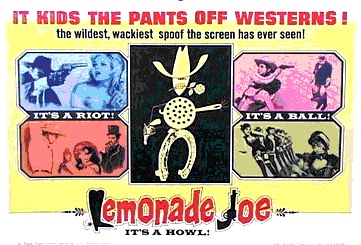
‘Lemonade Joe’ (complete name in CzechLimonádový Joe aneb Koňská opera’), is a Czechoslovak film from 1964, directed by Oldřich Lipský and written by Jiří Brdečka, based on his own novel and theatre play.

Squeaky-clean Joe is a straight-shootin’ gunfighter who drinks only lemonade, and takes on a town full of whisky-swigging hombres.

It satirises the American Western genre, parodies the old silent westerns, and pays homage to animated cartoons, with colour tinting, and speeded-up fight scenes.

Made under the communist regime in Czechoslovakia, I would guess it cost considerably less than the average Hollywood film of the time.

‘Lemonade Joe’ became a cult classic in Czechoslovakia, and apparently Henry Fonda was amongst its foreign admirers. Henry Fonda and me!

There is some relevance to the subject of pantomimes, not only with the characterisations, the slapstick, the musical numbers, the costumes, and the set designs, but the fact that G. Wizz has a Wild West panto almost complete. Watch this space!

Friday, 5 August 2011

BEGIN AT THE BEGINNING…

In a previous blog, I expressed my concern that these days, many amateur drama and operatic groups appear to be frantically following fads.

Recently, I received an e-mail message from someone planning to direct a pantomime, informing me of his choice of a particular musical number, with which he planned to end the show. I had never heard of the ‘song’, or the singer, so I did a Google search. This brought up a vainglorious video, which must have cost more than the GDP of a medium-sized, European country.

The flick lasts 234 seconds, and the average length of shot was no more than 2 seconds long. Subtract the special effects, the sound enhancement, and the hundreds of extras leaping about, and you are left with a trite, tuneless, con trick. As far as I was concerned, it was a load of phonus bolonus! Opium for the masses!

How on earth could an amateur group putting on a show in a village hall hope to come close to this presentation?

More importantly, why would they want to?

“But it’s popular!” would probably be the justification.


Apart from the fact that this offering had little to offer, I would advocate cutting one’s coat according to one’s cloth. Surely, rather than trying to match this technological tarradiddle, why not go for a lively, bouncy number packed with pep… one that the chorus, dancers, children and principals can join in and enjoy.

For example, for my version of ‘Hickory Dickory Dock’, I suggest finishing with ‘Rock Around The Clock’, which even has some relevance to the story. There is the possibility of bringing on some teddy boys and girls to bop, and ‘musicians’ with inflatable saxophones and guitars. It’s an easy number to learn, the choreography could be quite simple. Add a mirror ball or searchlight effect, get the audience clapping along, and the joint really would be rocking.

I once saw an amateur pantomime which included the character Little Bo Peep, who had three sheep. They came on for the finale and started off the musical number with, “Baa, baa, baa…”, leading into the Beach Boys’ ‘Barbara Ann’, with the rock ‘n’ roll element described above. Quite frankly, what had gone before wasn’t up to much, but the show did end with a bang.

Any road up, I was looking through a Sesame Street website the other day, and I came across reference to one episode, where Bob McGrath, who played the part of the character ‘Bob’ on the show, sang ‘Good Morning Starshine’, with some hippy Muppets.

The song is from the rock musical ‘Hair’, which dates from 1967. I saw the show on tour, maybe around 1970.

This started the creative juices flowing. For me, most modern music is unmemorable, but here is something that I reckon has stood the test of time – news yesterday that the musical production of 'Mary Poppins' (film -1964) dominated this year's Helpmann Awards in Australia, winning eight of the 12 categories in which it was nominated, including best musical – so I played some versions of it, posted on YouTube.

Normally, I like a pantomime to have a lively opening, to maybe convince the audience that it’s the start of a good show. However, just as a variation, for those who might want something that bit different, I thought that ‘Good Morning Starshine’ could work… providing of course that it’s done well.

So, here goes… yes, I know I have switched from an ending to an opening, but one has to begin somewhere. Here’s my idea… feel free to use it if you wish.

The houselights go down, the curtains are closed, and a golden glow, sunrise lighting effect is brought up slowly. A dawn chorus sound effect is played over the PA, and this fades as the curtains open to reveal the village setting, and the lights come up slowly to full.

The lead singer enters…

(http://youtu.be/Kl8O7NHkrPY – for the la-la opening and the attack. There is also a hint of an instrumental section, if you want to include dancers.)

…and is then joined by chorus and dancers, who wander on singing from all entrances to the stage. Opportunities for some nice grouping.

(http://youtu.be/-SzuZBotgCU - from 59 seconds into the video. Just one verse, one chorus, and then the finish, which could actually be bigger than it is here.)

Slow start, leisurely build up, then lots of pizzazz to the big finish. End the musical number with a tableau, then lots of animation, and sotto voce adlibs from the assembled throng, as you go into the opening dialogue… quickly followed by a crash, bang, wallop entrance, with sound effects and drum cues. 

(http://youtu.be/gkav2kjB0qc youtu.be/gkav2kjB0qc – for the ‘chorus’ involvement.)

Don’t make the tempo too slow.

I reckon it could be a knockout.


CLASS ACT #4


Actress Carmen D'Antonio performs an hilarious operatic spoof in the classic Vaudevillian style from the MGM movie, "Broadway Melody of 1940", which starred Fred Astaire and Eleanor Powell. She was born in Philadelphia in 1911. Had she been born on this side of the Atlantic, she would probably have had a very successful career in pantomime.

Notice how she doesn't try too hard to be funny. She gives the impression that she has confidence in her abilitiy and the material.

"Never stress or over-emphasize a point – let the gag do its own work." Billy Bennett (1887-1942)

Miss D’Antonio reminds me of Betty Jumel (1901-1990), who was billed as “A Bundle of Fun”. She appeared with Norman Evans in the 1944 Leeds Theatre Royal production of Humpty Dumpty, which set a record with its 22-week run from Christmas Eve to Whitsun. She also became one of the few successful female Dames, notably in 1948 as Dame Trot in Babes in the Wood at London’s Princes Theatre, and later starred alongside Terry-Thomas at the Palladium in Humpty Dumpty.

I like physical comedians… and comediennes!

Friday, 22 July 2011

THERE’LL BE SOME CHANGES MADE

Recently, I received an e-mail message from an amateur drama group who had been poring over one of my scripts for some 16 weeks. They informed me they “…really liked it…” , and loved “… all sorts of ingredients such as the drum use so carefully set out…”. They had apparently “… steered away from drum use… over the years, but this could be a turning point.”. The outcome was that they would “…very much like to proceed…” with the script. However, they had “…two requests…”

One was to “…import one or two routines…” (My italics!) The second was to expand the chorus involvement to accommodate a group of children, the bulk of which were of primary school age, to give them “… one or two lines each…”

I replied, thanking them for asking about the possibility of making alterations, pointing out that this was the exception rather than the rule, and informed them that if they let me know specifically what they had in mind, I would certainly have a look at modifying the script.

This has happened before, and on occasions, I have supplied alternative bits of dialogue and business, so that societies could pick and choose, and combine them in any number or order to cover their requirements.

In this case, I received a reply from the Director, informing me that the group liked my script very much, but felt that they needed “…the flexibility to make changes “… as and when the need arises, and not have to seek approval of each change” (My italics!)

I was also informed that “… late in the day, there can be the need for changes to accommodate a local or national topic of interest…” (My italics!)

The Director claimed that they had already presented 16 pantomimes, and “…have not had any issues with writers…”

To begin at the beginning…

The script I supplied to the group has, like all my scripts, a title page, on the reverse of which there is a heading in bold caps, ‘IMPORTANT NOTES – PLEASE READ CAREFULLY’. Note 5 reads, “No alteration to the title or script should be made without the author’s consent. All approved alterations of or suggestions for the script become the authors’ property.”

I can insist that this rule is adhered to, but in practice I have evidence that it is often completely ignored. Unless I attended every performance of my pantomimes, I have no way of knowing what alterations are made to the scripts, either during rehearsals, or on the 'spur of the moment' during a show, and the more 'cavalier' companies know this.

The fact that the Director in question referred to the local and national topics of interest, and the 16 pantomimes, suggests to me that this desire to alter scripts wasn’t a new one, so, a simple question… why didn’t the group ask about the procedure regarding script changes when they made their request for a reading copy? It would have been courteous, and it might have saved both parties considerable time and trouble.

Seeing as I wasn’t contacted about this issue immediately the group received the script, containing Note 5 above, did no one bother to read the notes, did someone read the notes and just ignore them, or did they read the notes and think that they were exempt?

In a previous blog, I said my piece about ad-libbing, but here, this is about someone wanting to make alterations to the script, without seeking the writer’s approval, even though he has offered to do the job for them.

What’s this, “…late in the day, there can be the need for changes to accommodate a local or national topic of interest…” nonsense? There is no need to include local or topical references at all.

Of course the defence of this need is that this is what audiences want. My belief, for what it is worth, is that if an amateur society manages to present a pantomime with good acting, dancing and singing, tuneful music and appropriate sound effects, well-designed sets, props and costumes, good quality sound and lighting, comfortable seating, with a good view of the stage, and they serve a decent cup of tea during the interval, then not one single member of the audience will leave the theatre complaining that the show was short on local or topical references. In fact, I guarantee it. I also guarantee that every society is going to fall well short on many of the requirements listed above. Even if they reach a high standard on all these aspects, they should be aware that however well you do a show, you can always do it better! A lorry-load of local and topical references will not rescue a poor production.

Personally, I would put drum cues well before topical references. Remember, this group had “… steered away from drum use… over the years...". More about the crash, bang, wallop later. Watch this space!

Some amateur operatic societies feel that it's imperative they include local or topical references in their pantomimes, but wouldn't dream of inserting them in a production of 'The King And I'! Is a puzzlement!

The outcome of the saga detailed above was that we both decided to go our separate ways.

To quote the great Billy Wilder again… “I have ten commandments. The first nine are, thou shalt not bore. The tenth is, thou shalt have right of final cut.”


CLASS ACT #3


In the light of the preceding grump, I decided to include the above.

Brassy, gangly, Cass Daley (born Catherine Dailey), (July 17, 1915 - March 22, 1975) was an American radio, television and film actress, singer, and comedienne. She started her career as a band vocalist, but was upstaged during one of her singing performances by a buffoonish emcee by the name of Red Skelton, and was inspired to switch to playing for laughs.

Some of her songs recorded for Decca Records include: "Abba Dabba Honeymoon", "Put the Blame on Mame" and "A Good Man Is Hard to Find".

Her eccentric, off-the-wall singing and dancing combined with her gawky, buck-toothed appearance endeared her to movie audiences in the 1940s and 1950s, most notably in knockabout comedies. 

I suppose you might describe this performance as… “Giving it some oomph!”


SPECIAL FREE OFFER
No strings attached!
I receive lots of correspondence from amateur drama/operatic societies, and it amazes me why so many don’t appear to have letter headings. I get notes written on the back of envelopes, bits of cardboard, and sheets from those wire-bound reporters’ notebooks, with the torn perforations still at the top.

So G. Wizz is offering to design, a letter heading, free, gratis and for nothing, for any bona fide drama/operatic group. Really!

Just send me an e-mail message and we’ll take it from there… as opposed to ‘Take It From Here’, which was a BBC radio comedy programme, broadcast between 1948 and 1960.

Written by Frank Muir and Denis Norden, it originally starred Jimmy Edwards, Dick Bentley and Joy Nichols, and later, June Whitfield and Alma Cogan. The show is perhaps most famous for introducing ‘The Glums’… "Oh really, Ron, do you expect me to just sit here, like a lemon?", to which the dim Ron responds "No thanks Eth, I've just had a banana." Think about it!

Hurry, hurry, hurry!


Thursday, 14 July 2011

MY BÊTE NOIR

If a person buys a self-assembly bookcase, on opening the carton, the chances are they will find that the kit comprises various pieces of wood, a polythene bag containing screws, dowels, etc., plus a booklet which describes the construction procedure, probably by means of simple line illustrations.

The individual could of course, ignore this booklet completely and attempt their own method of construction, but the end result would most likely, be something that looked nothing like a bookcase, and proved to be totally unsuitable for holding books.

It’s a fair bet that the instruction booklet has been prepared by people who knew what they were about, and if the purchaser followed it, step by step, they would quite quickly become the owner of a properly constructed, useful piece of furniture, and also have a sense of pride and achievement.

It seems rather strange therefore, that whilst only a fool would ignore the instructions in a booklet included with a self-assembly bookcase, and devise his or her own plan, certain people appear to think that it is perfectly acceptable, indeed, almost essential, to adopt a different approach with a pantomime script. They don’t trust the writer, or apparently, think that they know better.

A pantomime script should contain all the elements required to produce a successful show - even the screws, the dowels and those ‘special bits’ that hold it all together. It should have been written by someone who ‘knows what they are about’, and therefore, following this ‘book of instructions’ will produce the right kind of end product, something that not only serves its purpose, but can also be a proud possession, which is admired by other people.

The first function of the script is to inspire the interpretive artists - to make them say, “There are wonderful opportunities here for me.” Part of being a good actor is the ability to spot these opportunities, and make the best use of them. Unfortunately, some self-opinionated performers, whose skills generally tend to be average at best, see the script only as a means for them to set off on an ego trip. Their main concern, indeed sometimes their only concern, is what they can do for the script, rather than what the script can do for them.

The script’s second function is to supply the words the actors will speak. These words may have to be cut or changed deliberately, but there is no excuse for changing them at random, like the actor who ‘gets the idea’ and then paraphrases his speeches, or assumes that he can make up better words offhand than the playwright could after long thought. This assumption is rarely justified.

On page 3 of my script for ‘Robinson Crusoe’, there is the following to describe the entrance of the Dame:

FX                    MOTOR HORN OFF STAGE

CLARA             (OFF) Fresh fi-ish! Fre-esh fi-ish!

MUSIC CUE      COVER MUSIC - CLARA CRUSOE

ENTER CLARA CRUSOE PUSHING A CART LOADED WITH FISH. CART HAS A HORN ATTACHED AND A SIGN – ‘CLARA CRUSOE AND SONS, FISHMONGERS’

There follows some dialogue where Clara introduces herself, cracks a corny joke about fish, sings a few bars from a selection of ‘fish’ songs, in mock operatic fashion, whilst holding up examples of her piscatorial produce, and then throws some ‘sweetie shrimps’ to the audience. The fact that the sign on the cart reads, ‘CLARA CRUSOE AND SONS, FISHMONGERS’, tells the audience immediately who she is, and her relationship to two other members of the cast. The whole sequence occupies slightly less than a page of the script.

I went to see a  production put on by a group located not far from where I live, and wished that I hadn’t. The individual playing the Dame entered from the wings on a skateboard! There was no horn, which sets up the anticipation of a comedy entrance, and there was no cover music. He was obviously not used to the contraption, as around mid stage he fell of it, and went A over T! This was not a pre-arranged comedy fall, and so the drummer didn’t have a cymbal crash ready.

Unfortunately, the smatterer didn’t break his neck, but he did manage to dislodge the radio mike that had been fixed about his person. There followed a couple of minutes of fiddling under his costume, accompanied by almost inaudible, mumbled ad-libbing.

When the problem was eventually sorted out, he came to the front of the stage and asked for the houselights to be put on, so that he could ask spontaneous questions of the audience. Some faint replies necessitated repeating, and after four or five minutes of this nonsense, which seemed to last at least twice as long, he asked for the houselights to be taken out and he disappeared into the wings to return, pushing a supermarket trolley, with a ‘sign’ that had been written in felt-tip pen on the reverse of a side of a cornflake packet, attached to it. Then it was back to the script… sort of.

I was incensed. The whole sequence was a complete shambles, and showed that this imposter didn’t know the first thing about comedy.

Had he done this at rehearsals? If so, why hadn’t the director nipped it in the bud straight away? Had he saved this up for the first performance, and decided after weeks of rehearsing, to go his own way?

I was later informed that he would be playing Fagin in the society’s forthcoming production of ‘Oliver’. That got me thinking. Would he make his entrance as the "receiver of stolen goods", on a pogo stick, or maybe a unicycle! I doubt very much that he did!

When I arrived back home, I had calmed down somewhat, and I decided that I would read the script just to make sure that it did what it was supposed to do. I have never played a pantomime Dame in my life, but I acted out the scene in my living room, and it worked, perfectly well. It flowed and it was funny. 

In reviews of amateur shows I have noted the following… their ad-libbing in place of forgotten lines… added to the humour.” There you go, then! Don’t bother to learn the lines and the whole thing will be hilarious! Or maybe it won’t!

“Many of the best laughs came from the busload of Buttons fans in the cheap seats at the back. And from the spontaneous script embroidery which ensued. Inveterate ad-libber, Archer Turbild met his match this year in Norman Cowsedge. Another welcome newcomer was Arlene Lank, who played a sweet Cinderella, coping coolly with the improvisation around her.”

If Plan A above doesn’t work, try Plan B! Plant some wags in the one-and-nines, and have a duel in the Ad-Lib Stakes. If I had been Arlene I would have walked off the stage, and left the so-and-sos to it!

The names have been changed to protect the innocent… and the guilty!

When it comes to pantomimes, ad-libbers are my bête noir! They slow down a production, and wind me up!

I realise of course that they will continue, unchecked and un-funny, ad-libbing ad infinitum.

Heigh-ho!” says Anthony Rowley.


A GOOD IDEA, SON!
(A catchphrase used by Max Bygraves on the BBC Light Program comedy show, ‘Educating Archie’, broadcast in the 1950s.)

In my script for ‘Aladdin’, I have Abanazar, the Magnificent Magician from Morocco, gaze into a crystal ball, to discover that our hero has escaped from the fabled cave, with the magic lamp.

Recently, in toy and novelty shops, I have come across 100mm diameter Spectral Balls, High Bouncing Glitter Balls, Glitter Water Balls, and Light Up Air Balls, all of which would be ideal for the scene described above. Some of them have built in light-emitting gizmos, but the basic ones would most likely glitter considerably under the stage lights. They are available from only £1.99!

I see Abanazar producing one of these devices from a pocket inside his cloak or whatever, and with some artistic manipulation and dialogue over, make the ball come alive, as it were.

Perhaps there are other pantomimes where a crystal ball is consulted.

Try one or two of the moves as depicted on the video…


Don’t bother learning the whole routine!